Loading...
View on SubstackWriting software
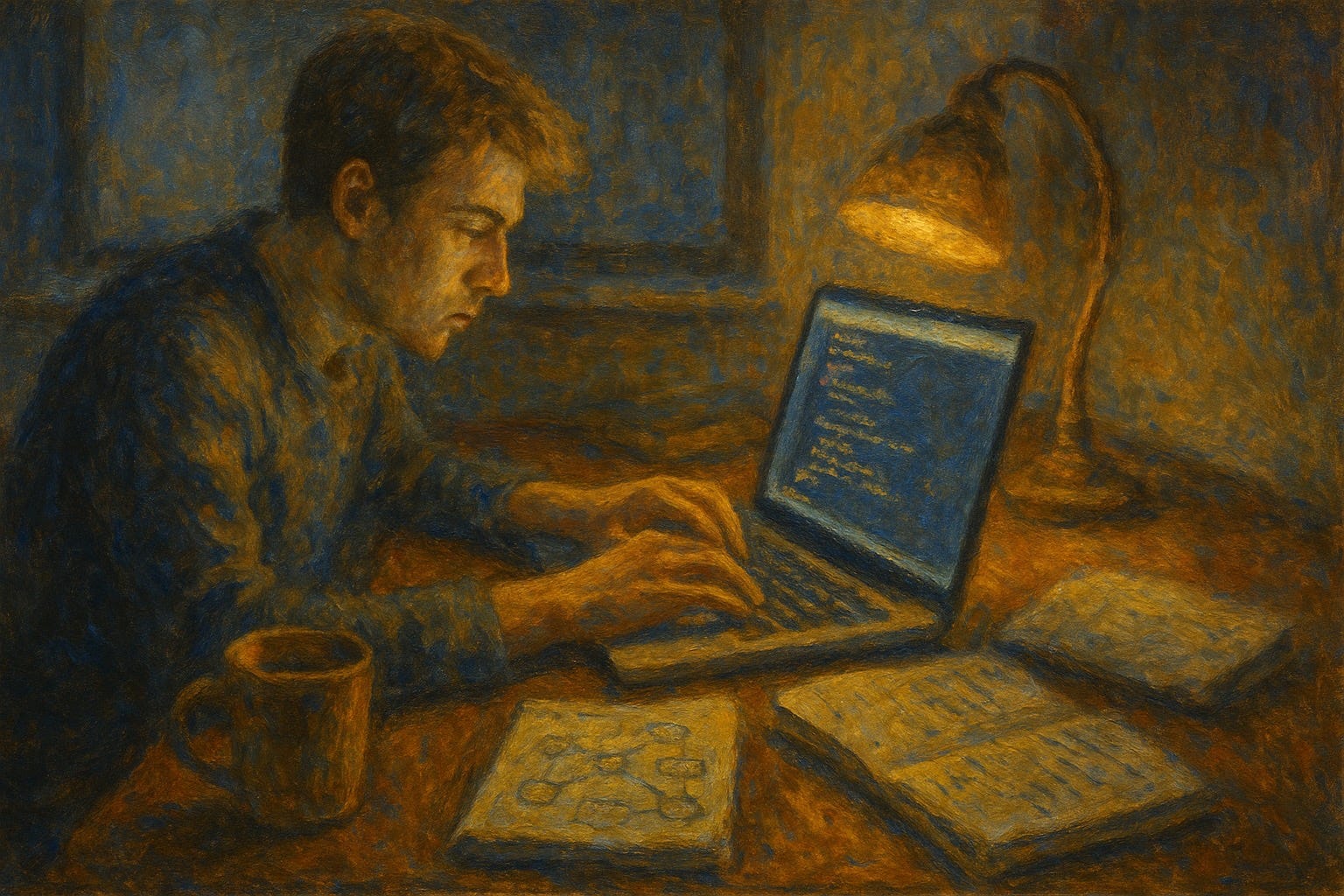
Ever feel like you're staring at a blank screen, wondering if you'll ever make sense of all those curly braces and loops?
That's exactly how I felt back in my early days with coding. It was overwhelming, like trying to learn a new language while blindfolded.
But somehow, I stuck with it, and now building software feels like second nature. Let me take you back to where it all started for me.
Picture this: I'm eight years old, huddled over my older sister's laptop.
She's just ten, tapping away at what looks like magic to me. Lines of HTML and CSS for her blog, turning plain text into colorful layouts with images and buttons.
Why not just use a regular word processor? I wondered, my eyes wide.
It was my first glimpse of code as something creative, not just instructions for a machine.
Fast forward to age ten.
I stumble on a YouTube video of some guy running shell scripts. He loops through commands to list files, claiming it'd speed up the computer. I had no idea if it was true, but I tried it anyway. Suddenly, my family's old desktop was spitting out file names in a frenzy. It was chaotic, a bit scary, but thrilling.
That rush of making the computer do my bidding hooked me early.
By twelve, I was bolder. I fired up Visual Studio, determined to crack open a binary file and see what made software tick.
Decompiling? I didn't know the first thing about it.
The screen filled with gibberish, error messages popping like fireworks. After hours of frustration, I gave up, slamming the laptop shut. It felt like peeking behind a locked door only to find a brick wall.
That defeat lingered.
Coding seemed like a puzzle for geniuses, not a kid messing around in his room. But those early tries planted a seed, even if it took years to sprout.
At sixteen, I got a full-day crash course in C.
It was intense, like drinking from a firehose.
Pointers, memory allocation, structs, all blurring together. I scribbled notes furiously, but half of it flew over my head.
Then came my first year of Computer Science class in 2018.
We dove into Python, tackling sorting algorithms and math puzzles that twisted my brain.
Bubble sorts, quick sorts, solving equations with code. It was a lot.
I remember sitting in that stuffy classroom, staring at the screen, thinking I'd never get it.
Desperation hit hard. Coding felt ten times tougher than learning German or Spanish, with concepts piling up like an endless to-do list.

Amid the chaos, something clicked.
Python's classes and decorators blew me away.
They weren't just tools; they felt like elegant art, wrapping logic in reusable layers. But our class stuck to basics, for loops and simple functions.
No one mentioned object-oriented programming yet.
It was like learning to drive without ever touching the steering wheel.
That gap nagged at me.
In early 2019, I decided to bridge it myself.
I built my first trading algorithm using the Coinbase API.
Picture me, a teenager, pulling live crypto prices and automating buys based on simple rules.
I dove into classes for the first time, creating objects that handled data streams and decisions.
Long-running scripts kept it alive overnight, watching markets while I slept.
It wasn't perfect, buggy as hell, but it worked.
That project turned despair into excitement.
Then COVID struck in 2020.
Lockdowns stranded me at home, classes went virtual, and the world felt frozen.
But I couldn't stop coding.
My CS teacher needed help with a tombola, like a raffle game for a charity event.
He gave me that task to build a full graphical user interface (GUI) using Python and Tkinter. Buttons for drawing numbers, displays for winners, even sound effects for the draws.
It was my first real GUI, windows popping up with colorful grids and spinning animations.
Late nights debugging button clicks and layout glitches paid off when we ran the event virtually.
Amid the isolation, that project connected me to something bigger, proving code could solve real problems, even fun ones.
Looking back, those early frustrations were just the warm-up. Starting in late 2019, I began coding seriously for myself, blending all those lessons into tools that fit my life. From shell scripts to trading bots, each step built confidence. If you're feeling lost in code right now, trust me, that overwhelming fog clears. What's one small project you could try today? It might just spark your own journey.